

01 / 07 · Target 2029
Launch
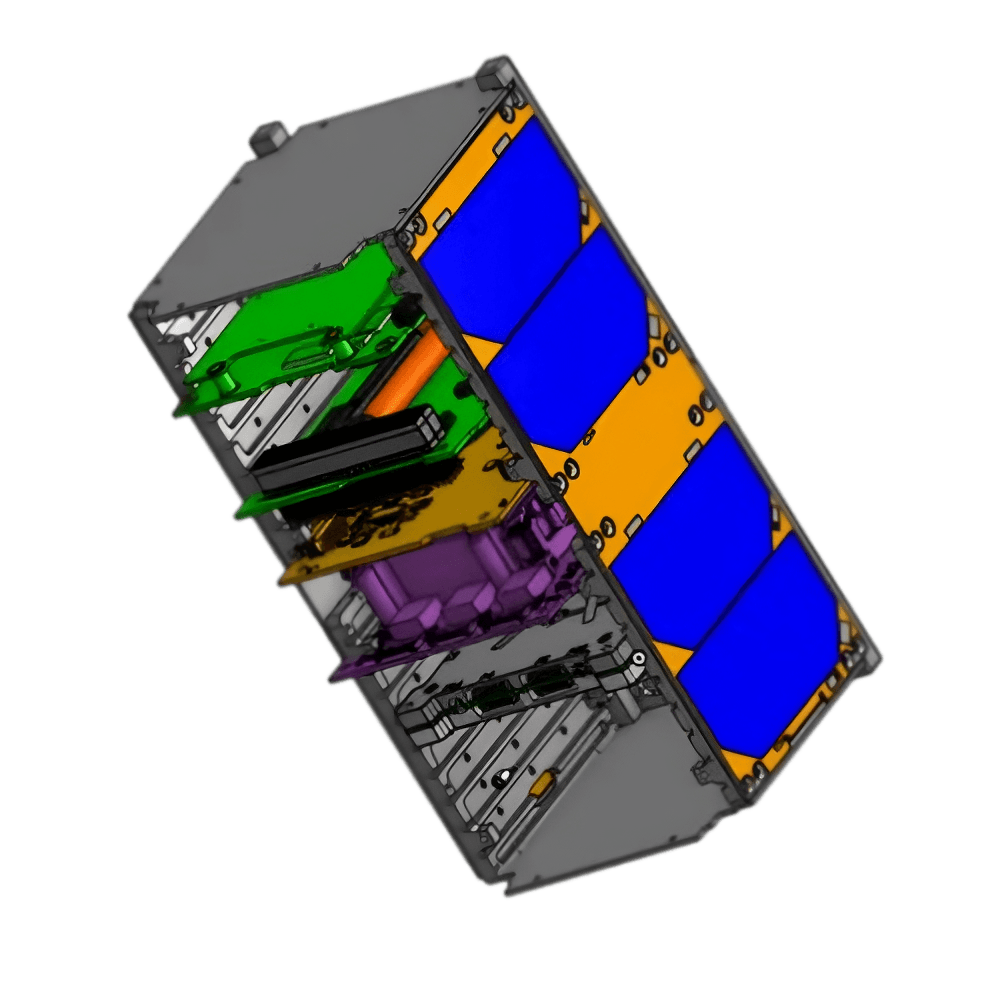
After two to three years of design and testing on campus, SPACE RACCOON rides to orbit as a compact 2U CubeSat: the first satellite ever built at Tufts.
- 2U CubeSat
- COTS components
- Systems engineering
Tufts CubeSat Team
SPACE RACCOON is a 2U CubeSat mission using onboard computer vision and machine learning to detect, classify, and assess collision risk in Low Earth Orbit.
The mission
01 / 07 · Target 2029
After two to three years of design and testing on campus, SPACE RACCOON rides to orbit as a compact 2U CubeSat: the first satellite ever built at Tufts.
02 / 07 · Low Earth Orbit · 14 months
Deployed into Low Earth Orbit for a 14-month mission, the satellite runs on body-mounted solar cells and holds its attitude with in-house reaction wheels.
03 / 07 · Vision payload
During scheduled imaging windows a modified GoPro captures a frame every 30 seconds, searching for debris against the star field.
04 / 07 · Onboard computer vision
Image processing isolates each object and a neural network classifies it (fragment, rocket body, defunct satellite) right on the spacecraft.
05 / 07 · Collision screening
Tracks across frames feed a collision-risk assessment that flags the objects that matter most to anything else flying in LEO.
06 / 07 · VHF / UHF
Only frames that contain debris are compressed, packetized, and sent over our radio link to a student-built ground station.
07 / 07 · Open source
Flight software and debris data are released openly to support safer orbital operations and the student teams that come after us.
Inside SPACE RACCOON
A 2U CubeSat is just 10 × 10 × 22.7 cm. Inside that volume each subteam owns a slice of the stack: the chassis and orbit analysis, power, flight software and vision, and the radio link home.
Five subteams
Roadmap
September
October
November
December
February
March
Where we and our alumni work
Last updated: September 27, 2026